

Hire an Entire Team or Partner With an Agency? A Smarter Way to Start a Business.
Before adding five, eight, or ten people to your payroll, there is another question worth asking: which capabilities truly need to be built in-house from Day 1—and which can already be handled by a team built to support you?
Starting a business sounds exciting when you are still imagining the logo, the store, the products, the customers, and the day you finally announce: “We’re open.”
Then reality arrives.
Who will handle recruitment? Who will prepare employee files, policies, payroll processes, and HR documentation? Who will take care of bookkeeping, financial reports, internal controls, and compliance?
Who will build the website? Who will manage Facebook, Instagram, TikTok, Google Business Profile, content creation, photography, graphic design, advertising, and SEO?
Who will establish the systems your employees need? Who will organize workflows? And perhaps the most important question: who will help you think about the business while you are busy trying to operate it?

The Part of Starting a Business Nobody Puts on the Grand Opening Poster
A new business does not only need people who can sell the product or serve the customer. Behind every business that appears organized from the outside is an entire backend operation keeping things running.
For Filipino entrepreneurs, particularly owners of micro, small, and medium enterprises, this matters enormously.
Many businesses begin with limited manpower, limited capital, and an owner wearing five, ten, sometimes twenty different hats.
Do you really need to build every department yourself—or can you launch faster by accessing an existing team that already has the expertise, tools, and systems you need?
The Traditional Route: Build Everything From Scratch
Imagine opening a restaurant, retail store, distribution company, clinic, service business, or another new venture.
Before opening day, you may eventually need HR and administrative support, accounting and payroll capability, a graphic designer, social media management, photography or video production, marketing, website development, technical support, and people who can help establish workflows and systems.
Not every company needs all of those positions immediately. But the work itself still needs to be done.
Hiring is also only Step 1. Once employees are hired, the business takes responsibility for salaries, onboarding, supervision, training, equipment, workspace, software subscriptions, performance management, turnover, and applicable employer obligations.
Those are normal parts of becoming an employer. But when a business is just beginning, they arrive at exactly the same time the owner is trying to attract customers, stabilize operations, control cash flow, and generate revenue.
Salary Is Only Part of the Real Cost of Building a Department
A business owner might look at a monthly salary and conclude that hiring one employee is automatically cheaper than hiring an agency.
But salary is rarely the complete cost of capability.
A marketing employee, for example, may need a capable computer, photography or production equipment, editing and design software, cloud storage, advertising tools, training, workspace, internet access, and management support.
And even after all that, one individual may not be equally strong in branding, graphic design, photography, videography, SEO, website development, copywriting, advertising, analytics, and marketing strategy.
The same issue appears in HR, finance, technology, and operations.
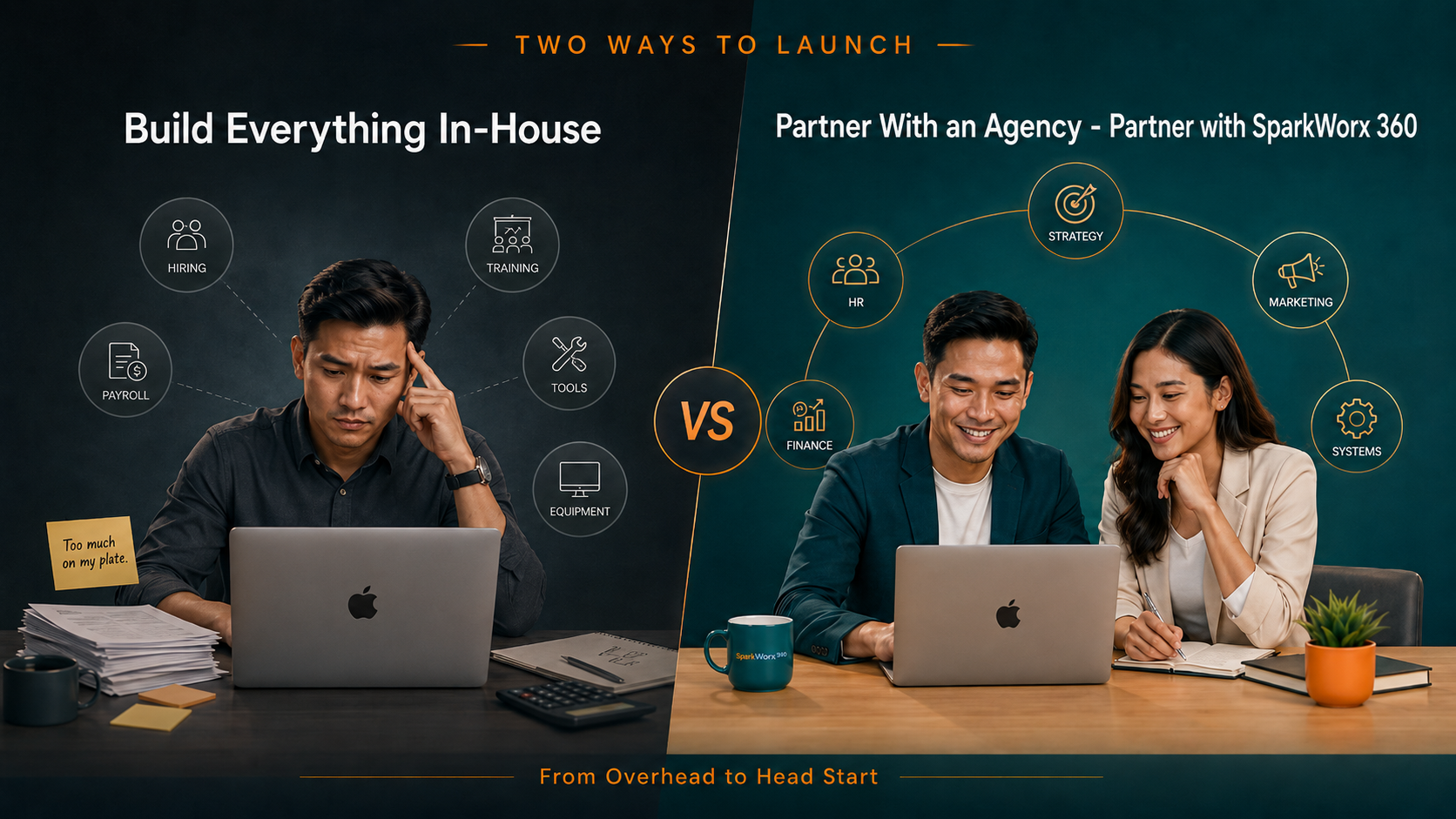
The real comparison is not simply “employee versus agency.” It is building an entire capability internally versus accessing a team that already has that capability.
You Can Start the Business Faster
One of the biggest disadvantages of building every capability internally is time.
Recruitment takes time. Interviews take time. Negotiations take time. Onboarding takes time. Training takes time. Sometimes, after weeks of searching, the hire simply does not work out and the process begins again.
Meanwhile, rent may already be running. Inventory may already have been purchased. Equipment may already have arrived. The business may already be spending money without generating meaningful revenue.
A capable business solutions partner allows several startup requirements to move in parallel instead of one after another.
While HR structures are being organized, branding can move forward. While the website is being prepared, marketing content can be created. While workflows are being developed, systems can be configured. While employees are being onboarded, launch campaigns can already be planned.
Shorten the distance between “We are starting a business” and “We are ready to operate.”
You Launch With Marketing—Instead of Thinking About Marketing After Opening
One of the most common startup mistakes is treating marketing as something to worry about after opening.
The store opens. The products arrive. Employees are waiting. Then somebody asks: “Okay… how do customers find us?”
That question should be answered before opening day.
Philippine consumers increasingly discover and evaluate businesses digitally. They may search Google before visiting, inspect a Facebook page before messaging, watch a Reel before discovering a product, or compare several providers without ever stepping inside a store.
This means digital presence is no longer merely an advertising activity. For many modern businesses, it is part of business infrastructure.
When your business partner also provides digital marketing and website support , brand positioning, website development, online profiles, launch campaigns, content production, SEO, photography, and paid-media preparation can begin before the doors officially open.
Instead of opening quietly and then spending months trying to become visible, the business enters the market with momentum.
You Gain Specialists Without Hiring Every Specialist
Consider digital marketing alone. A strong campaign can require strategy, copywriting, design, photography, video editing, social media management, SEO, website support, paid advertising, and analytics.
Finding one employee who is excellent at every one of those disciplines is difficult.
The same applies across a business. An accountant is not automatically an HR specialist. An HR professional is not a software developer. A graphic designer is not automatically a business strategist. A developer does not automatically understand financial internal controls.
A multidisciplinary business solutions partner allows the right capability to be applied depending on the actual problem.
Costs and Deliverables Can Become More Predictable
Startups need to protect cash flow.
A properly structured agency agreement can clearly define scope, responsibilities, deliverables, frequency, timelines, and cost.
Instead of repeatedly discovering that another employee needs another tool, subscription, device, training program, or outsourced specialist, the business can define what support it actually needs and what the provider is committed to deliver.
The key is clarity. A professional engagement should never depend on vague statements such as “we will handle your marketing” or “we will help with HR.”
Deliverables, limits, responsibilities, support levels, and work that requires additional quotation should be clear from the beginning.
You Reduce Dependence on One Employee Knowing Everything
Almost every growing business eventually encounters a familiar situation.
One employee knows the passwords. The files. The spreadsheet. The supplier. The process. The software. The reporting method.
Then one Monday morning:
“Sir/Ma’am, I would like to submit my resignation.”
The company suddenly discovers that an entire function depended on one individual.
A structured agency should have documentation, shared resources, organizational processes, and multiple people capable of supporting an engagement.
People can still change. But the capability does not necessarily disappear with one resignation.
You Spend More Time Building the Business Instead of Becoming Its Backend Department
Business owners should understand what happens inside their companies. But understanding everything does not mean personally doing everything.
The entrepreneur’s highest-value time may be better spent on customers, products, sales, supplier relationships, partnerships, expansion, service quality, and business direction.
Yet many entrepreneurs spend their first year following up documents, fixing spreadsheets, creating Facebook posts at midnight, interviewing applicants, learning payroll, troubleshooting websites, designing posters, and searching online for tutorials.
That may work in the beginning. It is difficult to scale.

You Gain a Team That Thinks With You
Sometimes a business owner does not need another pair of hands. The owner needs another perspective.
Should we expand? Hire? Automate? Why are customers not converting? Why is this workflow failing? Where is cash being wasted?
A multidisciplinary team can examine the same business from several directions instead of viewing every issue through one job description.
Marketing affects operations. Operations affect manpower. Manpower affects payroll. Payroll affects cash flow. Cash flow affects expansion. Expansion affects systems. Systems affect customer experience.
Business problems rarely stay neatly inside departmental boxes.
The value of a 360-degree partner is not simply having more people. It is having different disciplines thinking about the same business.
You Can Build Better Systems Before Growth Becomes Chaos
Many companies only think about systems when the business becomes difficult to manage.
It usually begins innocently:
“Excel muna.”
Then another spreadsheet appears. Then another. Different employees maintain different versions. Eventually nobody is completely sure which file is correct.
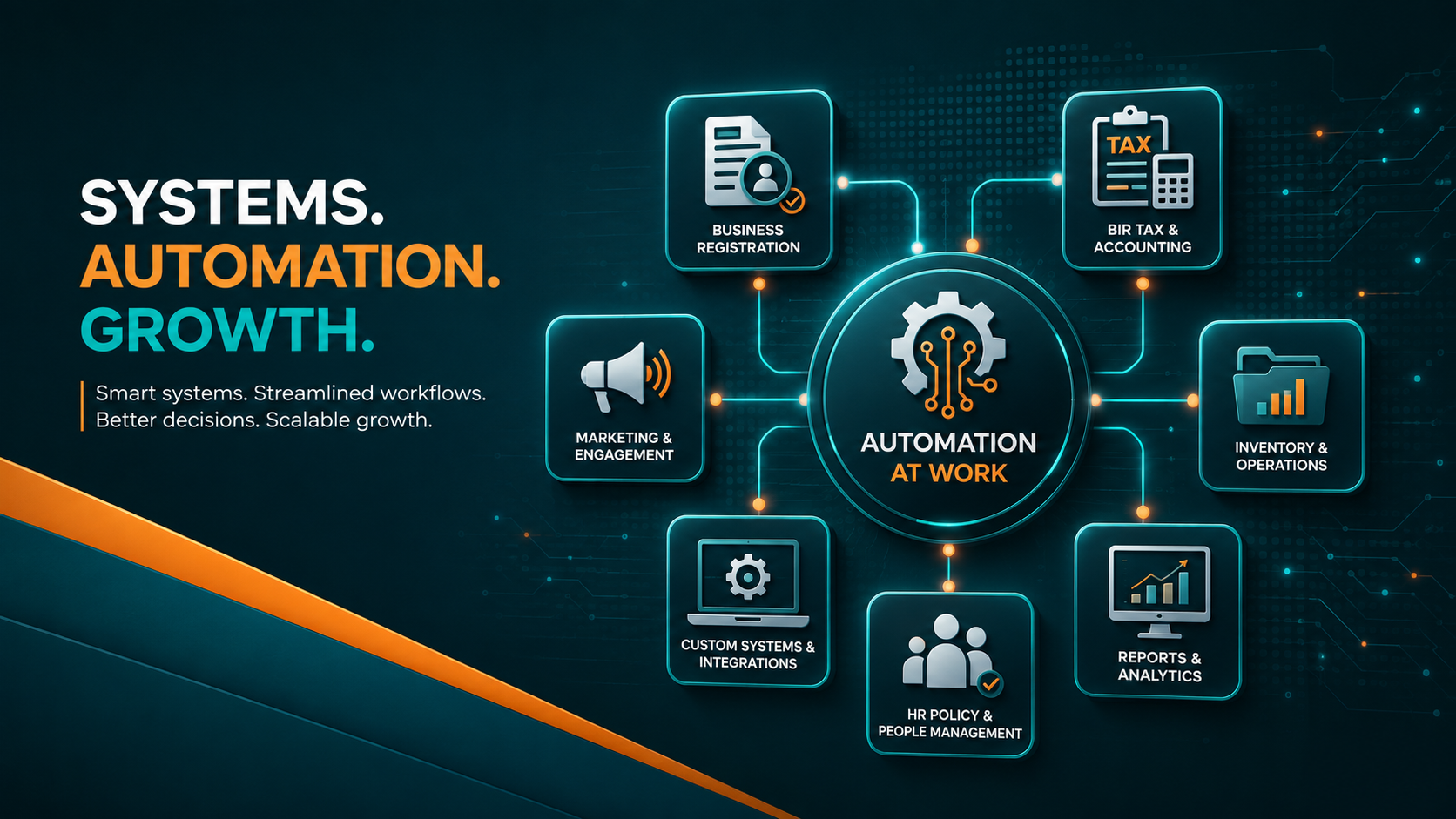
The same problem happens with attendance, inventory, payroll, employee records, sales monitoring, customer information, approvals, and internal reports.
It is often easier to establish sensible processes before the company becomes complicated than to repair years of fragmented processes later.
Working with a business systems and automation partner lets entrepreneurs ask early: What should be automated? What should be tracked? Who approves what? What data will management need? What happens when Branch No. 2 opens?
Support Can Scale as the Business Changes
Startup requirements do not stay constant.
Launch month may demand heavy marketing. Recruitment periods may require more HR support. A branch opening may require new workflows and systems. Expansion may require stronger financial visibility and internal controls.
Hiring permanent employees for every temporary increase in specialized work can add fixed overhead before the business really needs it.
An outsourced model can provide greater flexibility when scope and commercial arrangements are adjusted around actual business requirements.
Build permanent internal capacity where it creates lasting value. Access specialized capacity when you need specialized capacity.
You Avoid Becoming the Coordinator of Too Many Separate Suppliers
Another hidden startup problem is vendor fragmentation.
One company builds the website. Someone else handles Facebook. Another consultant handles HR. A freelancer makes graphics. Another provider works on accounting. Someone else develops a system.
Then something goes wrong.
“That’s not part of our scope.”
Suddenly the entrepreneur becomes the person responsible for connecting everyone.
Specialized vendors absolutely have their place. But having one primary business solutions partner can simplify coordination across functions that naturally overlap.
Startups Can Access Infrastructure They Are Not Yet Ready to Build
Established businesses have departments.
Startups often have a group chat.
There is nothing wrong with that. Every established organization started somewhere.
But young companies still need many of the capabilities mature organizations use: design software, project-management tools, reporting systems, production equipment, HR documentation, accounting processes, automation platforms, analytics, and experienced professionals.
Building all of this internally requires capital.
Partnering with an established provider allows a smaller organization to access infrastructure that has already been built and therefore operate more professionally earlier in its life cycle.
You Can Build Your Permanent Team When the Business Is Actually Ready
Working with an agency does not mean a company should never create internal departments.
In fact, the strongest long-term model for many businesses may eventually be a hybrid structure.
An agency helps establish the foundation. Processes become clearer. Revenue stabilizes. Management learns which functions truly require dedicated full-time personnel.
Then the company hires strategically.
This is very different from adding multiple permanent positions before operations begin simply because the owner assumes those positions will eventually be necessary.
Outsourcing can bridge the gap between startup and established organization.
So, Is Hiring an Agency Always Better Than Hiring Employees?
No.
Certain roles absolutely belong inside the company.
Core operational employees, managers, customer-facing staff, production teams, and roles requiring continuous on-site involvement may need to remain internal.
The smarter question is:
Which functions genuinely need to be internal today—and which capabilities can the business access more efficiently through a specialist partner?
A restaurant still needs its kitchen and service crew. A retail store still needs customer-facing staff. A distribution company still requires operational employees.
But does that restaurant also need a full-time photographer, graphic designer, SEO specialist, web developer, HR consultant, systems developer, and marketing strategist on Day 1?
Probably not.
Think About the Cost of Delay—not Just the Cost of the Service
Entrepreneurs naturally compare prices. They should.
But one cost almost never appears on a quotation: the cost of delay.
What does it cost if opening is delayed because recruitment is incomplete? What does it cost when a business opens but almost nobody knows about it? What does it cost when employees spend hours doing work that could have been automated?
What does it cost when management cannot see accurate information? What does it cost when a critical employee resigns and nobody else knows the process? What does it cost when the owner spends most of the week managing backend tasks instead of building the company?
Cheap is not always inexpensive. Expensive is not always costly. Sometimes the most valuable startup investment is reaching operational stability faster.
Starting a Business in Bacolod—or Anywhere in the Philippines? Build the Business, Not Every Department
For entrepreneurs in Bacolod City, Negros Occidental, Western Visayas, and across the Philippines , the traditional approach to starting a company is changing.
Business owners no longer need to assume that every capability must immediately become another full-time position on the payroll.
Modern businesses can combine a strong internal operational team with specialized external partners.
The objective is not to eliminate employees. The objective is to place resources where they create the greatest value.
Your employees operate the business. Your specialists strengthen the business. Your systems organize the business. Your marketing brings people to the business. And your strategy determines where the business goes next.
Where SparkWorx 360 Comes In
At SparkWorx 360, we believe entrepreneurs should not have to build every backend capability from scratch before they can begin moving forward.
Our role is to provide practical, structured support around the areas your organization actually needs—without unnecessary complexity or one-size-fits-all solutions.
Depending on the agreed engagement scope, SparkWorx 360 provides support across areas including:
- Startup and new business support
- Management and business consulting
- Operational structure and process support
- Business registration and compliance assistance
- General accounting and bookkeeping support
- Payroll systems and financial reporting support
- HR controls, policies, documentation, and management support
- Website development and digital presence
- Social media, content, SEO, and digital marketing
- Business automation and custom software solutions
You can view our current business services here or explore our custom software and automation solutions .
Our approach is based on a straightforward principle: understanding first, solutions second.
Marketing should understand operations. HR should understand growth plans. Technology should understand business processes. Financial information should support management decisions. Strategy should connect everything.
That is what a genuine 360-degree business solutions approach should accomplish.
The Goal Is Not Simply to Outsource Work. It Is to Start Smarter.
If you are planning to start a business in the Philippines, there will always be a temptation to do everything yourself first.
Sometimes that is necessary.
But before hiring another employee simply because a task needs to be completed, ask whether that capability really needs to become a permanent internal position right now.
Consider the real cost after equipment, tools, employer obligations, training, recruitment, and management time. Consider whether a team of specialists could accomplish the work faster. Consider whether capital can be deployed somewhere more important.
Most importantly, ask:
Where should I, as the business owner, actually be spending my time?
The goal of entrepreneurship is not to become the HR officer, accountant, designer, marketer, IT support technician, and administrator of your own company.
The goal is to build a business that can eventually operate without everything depending on you.
Sometimes that begins by hiring the right employees. Sometimes it begins by choosing the right external partner.
Often, the smartest answer is a combination of both.
Start With a Head Start
Launching a company will always involve risk. There will always be decisions, processes to build, and problems nobody anticipated.
But entrepreneurs no longer have to face every stage alone.
With the right business solutions partner, a company can begin with stronger HR structures, operational processes, digital presence, marketing capability, systems, and strategic guidance already supporting the journey.
Less time building every department from zero. More time building the business itself.
Frequently Asked Questions
Is outsourcing cheaper than hiring employees in the Philippines?
It depends on the role and scope. The right comparison should include not only salary but also employer obligations, equipment, software, workspace, recruitment, training, supervision, and the number of different specialists required to produce the same capability.
Should a startup outsource all of its business functions?
Usually not. Core operations and customer-facing functions often belong in-house. Specialized functions such as marketing, systems, certain HR support, consulting, website development, automation, and other professional services may be appropriate to outsource depending on the business.
What services can a new business outsource?
Depending on the business and provider, common outsourced areas can include business setup support, HR systems, accounting support, payroll systems, compliance assistance, websites, SEO, social media, digital marketing, process design, automation, software development, and business consulting.
Does SparkWorx 360 work only with businesses in Bacolod?
SparkWorx 360 is based in Bacolod City. Certain location-dependent services are focused on Bacolod and nearby areas, while services including digital marketing, website development, technology solutions, and management consulting can support businesses in other parts of the Philippines depending on the engagement.
Philippine Data Sources
MSME statistics: Department of Trade and Industry — Philippine MSME Statistics . The DTI reports that 99.63% of registered Philippine business establishments in 2024 were MSMEs.
Digital economy: Philippine Statistics Authority — Philippine Digital Economy 2025 . PSA reported ₱2.74 trillion in gross value added from the Philippine digital economy in 2025.
Social media usage: Philippine Statistics Authority — 2024 FLEMMS . PSA reported that 80.5% of Filipinos aged 10 to 64 used the internet for social media in 2024.
You don’t have to build every department before you can build your business.
Whether you are preparing to launch, opening another branch, improving a growing family business, or strengthening your existing operations, SparkWorx 360 can help identify what should stay in-house, what can be supported externally, and what systems you may need for the next stage.


